
TATAMIS
Order
-

 VINYL TATAMI MATS WITHOUT UNDERLAY 200 x 100cmVINYL TATAMI MATS WITHOUT UNDERLAY 200 x 100cm
- Standard price
-
121,20€ 151,20€ - Standard price
-
- Price list
-
121,20€ 151,20€
Quick view
-

 ANTI-SLIP VINYL TATAMIS 200 x 100cmANTI-SLIP VINYL TATAMIS 200 x 100cm
- Standard price
-
130,80€ 164,40€ - Standard price
-
- Price list
-
130,80€ 164,40€
Quick view
-

 MMA TATAMIS BARE BOTTOM 200 x 100 cmMMA TATAMIS BARE BOTTOM 200 x 100 cm
- Standard price
-
145,00€ 160,00€ - Standard price
-
- Price list
-
145,00€ 160,00€
Quick view
-

 ANTI-SLIP MMA TATAMIS 200 x 100 cmANTI-SLIP MMA TATAMIS 200 x 100 cm
- Standard price
-
150,00€ 165,00€ - Standard price
-
- Price list
-
150,00€ 165,00€
Quick view
-

 FOAM CARPET PADFOAM CARPET PAD
- Standard price
-
37,60€ 58,80€ - Standard price
-
- Price list
-
37,60€ 58,80€
Quick view
-

 WALL PROTECTIONS GREY DENSITY 170 KG/m3WALL PROTECTIONS GREY DENSITY 170 KG/m3
- Standard price
-
100,00€ - Standard price
-
- Price list
-
100,00€
Quick view


★★★★★ 4.9/5 on Google: over 340 customer reviews on our Mosaik Floor - PVC Tile Expert (Lyon) listing.
In short: MOSAIK-FLOOR manufactures vinyl tatami mats in France measuring 200 x 100 cm (2 m² per mat), with a density of 230 kg/m³, in thicknesses of 3, 4, 5, and 6 cm for judo, jiu-jitsu, and martial arts, and in 4 and 5 cm thicknesses for MMA and grappling. Smooth underside for a framed area; non-slip underside for loose installation. Competition version with a density of 270 kg/m³ (FFJDA recommendation for competition) available upon request. Starting at €121.20 per tatami; quotes for clubs and dojos within 24 hours; delivery throughout France and Europe.
Tatami mats chosen by a champion: MOSAIK-FLOOR was founded by Lionel Hugonnier, a two-time world jiu-jitsu champion (1994 and 1996), European jiu-jitsu champion (1995), French judo champion, and former member of the French national judo team representing PSG Judo. He knows the requirements of a tatami mat firsthand: shock absorption, mat stability, and grip on the floor.
They equipped their dojo with our tatami mats
- Paris Saint-Germain Judo: 200 m² of 5-cm-thick non-slip tatami mats and 50 m of wall protection installed in one day
- Saint-Genis-les-Ollières Dojo (69): 200 m² of 5-cm-thick EN 12503-3 tatami mats on a foam underlay and 45 m of wall protection, installed in 48 hours
Guides to Choosing Your Tatami Mats
- Buying Tatami Mats for a Club or Organization: The 2026 Guide (Suppliers, Standards, Budget)
- Tatami Mats for Clubs and Dojos: Prices, Thickness, and Quantity (Price Chart and Budget Examples)
- Judo Mats, MMA Mats, or Puzzle Mats: A Comparison (Standards, Price per Square Meter, Uses)
- What kind of flooring should you choose for a dojo?
- Tatami Puzzles vs. Traditional Tatami: A Comparison
- What is the thickness of the puzzle-style tatami mats: 20 mm or 40 mm?
- 40-mm or 50-mm Tatami Puzzle?
- How to Install Puzzle-Style Tatami Mats in a Dojo
- Tatami mats, puzzle mats, and shock-absorbing tiles: the complete line
Martial Arts Mats
100% Made in France — judo, karate, aikido, jujitsu, MMA
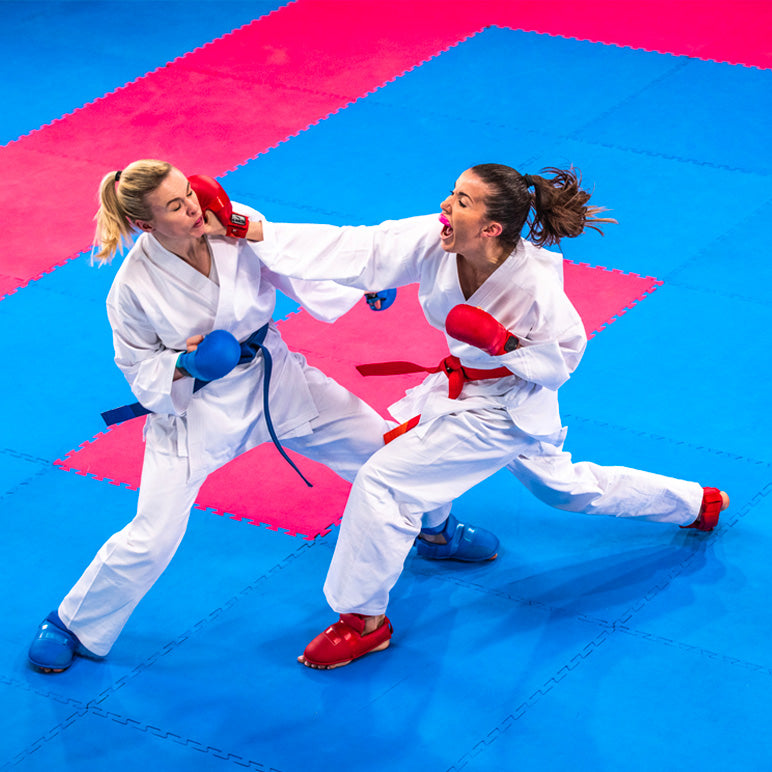
Our tatami mats are used in dojos as well as at international competitions, including the Olympic Games. They consist of a core made of high-quality agglomerated polyurethane foam, covered with PVC-coated vinyl—a construction that can make use of end-of-life foam or post-industrial waste. Each model is available with or without a non-slip backing.
Puzzle Mat
Whether for a multipurpose room, a tight budget, or home use: the EVA foam puzzle mat assembles without glue or tools, and comes apart just as quickly as it goes together.
Reversible—two colors on a single rug; simply flip it over. Non-slip rice straw surface, density 105 kg/m³, finished edges included, 2-year warranty.
Which tatami mat is right for your practice?
Two families, one key question to start with: Do you mainly train standing up—judo, karate, aikido, jujitsu—or on the ground, in MMA and grappling? It’s the surface of the flooring that changes, and it changes everything.
| VINYL MATSTraditional Martial Arts | TATAMIMMA Ground Fighting | |
|---|---|---|
| Area | Heavyweight, rice-straw-textured vinyl — the classic look of a dojo | Perfectly smooth, heat-sealed vinyl—prevents friction burns |
| Dimensions | 200 x 100 cm | 200 x 100 cm |
| Thicknesses | 3, 4, 5, or 6 cm | 4 or 5 cm |
| Density | Foam designed for judo mats, available in various densities depending on the level of practice | 230 kg/m³ — agglomerated polyurethane flakes, high Bultex content |
| Subjects | Judo, aikido, jujitsu, karate | MMA, grappling, wrestling |
| Labels | FFJDA and IJF | FFJDA — used in international competition |
| Deadline | 4 to 5 weeks | 4 weeks |
| From | €121.20 per tatami mat | €145.00 per tatami mat |
- Rice-straw-textured vinyl
- 200 x 100 cm, 3 to 6 cm thick
- Judo, aikido, jujitsu, karate
- FFJDA and IJF Labels
- Smooth vinyl flooring that doesn't leave burn marks on the floor
- 200 x 100 cm, 4 or 5 cm thick
- Density: 230 kg/m³
- FFJDA Certification, Competition
Bare bottom or non-slip bottom?
This is the second decision you need to make, and it depends entirely on your room.
Non-slip bottom
A thermoformed polyurethane foam layer beneath the tatami prevents it from sliding on a smooth floor. This is the default option whenever the mats are not secured around the edges: it prevents gaps from forming between the mats during training.
Non-slip vinyl tatami matsNon-slip MMA Tatami MatsNo Underwear
Choose this option when the surface is framed—walls, wooden battens, recessed frame—or laid on a surface that is already secure. The mats cannot shift, so the non-slip backing is unnecessary, and the tatami is less expensive.
Vinyl tatami mats with bare undersidesMMA Tatami Mats with Bare Bottoms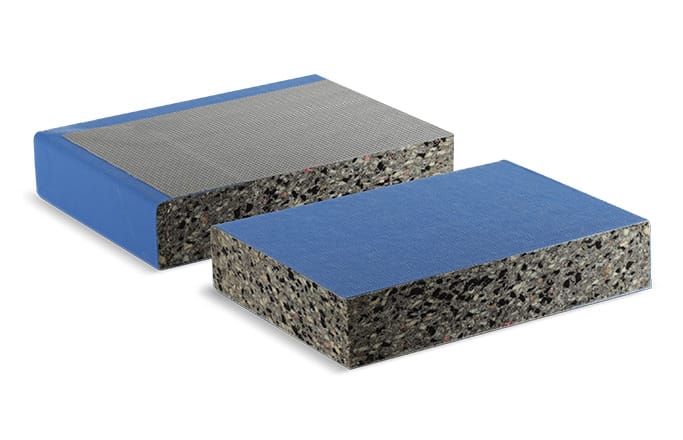
Composition
Core: layer of high-quality bonded polyurethane foam.
Cover: PVC-coated vinyl, laminated sides and underside, welded corners.
- European Standard EN 12503-3
- 5-year warranty
- M4 Fire Rating
- Made in France
- FFJDA label (French Judo Federation)
- IJF (International Judo Federation) label on the vinyl collection
Our judo mats are built to last, but their longevity depends largely on how they are cared for. Cleaning is essential to keeping the mats safe and hygienic—improper cleaning does more harm than good. The same goes for handling and storage: a tatami mat that is folded or stacked haphazardly will become misshapen.
FREQUENTLY ASKED QUESTIONS
What thickness of tatami should I choose?
The vinyl line is available in 3, 4, 5, and 6 cm; the MMA line is available in 4 and 5 cm. The choice depends on the sport and skill level: the higher and more frequent the throws, the greater the cushioning needed.
In practice, the 4-cm mat is suitable for most multipurpose dojos, while the 5- and 6-cm mats are designed for judo clubs where there is a lot of throwing. Tell us how you plan to use it, and we’ll help you choose the right one.
Bare bottom or non-slip bottom?
The non-slip backing, made of thermoformed polyurethane foam, prevents the tatami from sliding on a smooth floor. It is the default choice whenever the mats are not secured around the edges: it prevents gaps from forming between the mats during training.
The bare underside is chosen when the surface is framed—walls, wooden battens, a recessed frame—or laid on a surface that is already secure. In these cases, the mats cannot shift, and tatami is less expensive.
How many tatami mats do I need for my space?
A 200 x 100 cm tatami mat covers 2 m². So divide the area of your practice space by two to determine the number of mats needed.
For a 100 m² dojo, allow for 50 tatami mats. Be sure to measure the actual practice area, excluding walkways and storage areas.
Should I install an underlay?
On a hard floor—concrete, slab, or screed—this is strongly recommended. The underlay made of agglomerated polyurethane foam, with a density of 180 kg/m³, provides the cushioning that the subfloor lacks and reduces stress on the joints during repeated falls.
On a flexible wooden floor, it is optional. The underlay comes in the same size as the tatami mats—200 x 100 cm—and in various thicknesses.
Are wall guards required?
Yes, as soon as the distance between the edge of the carpet and a wall or obstacle is less than 100 cm. This is a safety rule, not an option.
Our polyurethane foam panels, with a density of 170 kg/m³ and covered with M2-rated fire-resistant faux leather, are available in 150 x 100 cm and 200 x 100 cm sizes, with a thickness of 2.5 cm. They are designed to be glued to the wall.
What is the difference between a judo mat and an MMA mat?
The surface. Judo tatami is covered with a heavy vinyl with a rice-straw texture—the classic dojo look—which provides good grip for standing techniques. MMA tatami is covered with a perfectly smooth vinyl.
This difference is crucial: in MMA and grappling, ground fighting is constant, and a textured surface causes friction burns. The smooth surface eliminates these burns and makes it easier to move around on the ground.
What does a density of 230 kg/m³ mean?
It is the density of the foam that determines both cushioning and durability. Foam that is not dense enough will compress and lose its properties within a few seasons.
230 kg/m³ is the standard density used in French dojos—the same as that of our MMA tatami mats. The vinyl line is available in several densities depending on the level of practice.
Is there a minimum order, and what is the lead time?
The minimum order is 10 pieces. Since the tatami mats are made to order in France, please allow 4 weeks for the MMA line and 4 to 5 weeks for the vinyl line.
So plan ahead for your summer projects: lead times naturally get longer as the start of the sports season approaches.
How do you care for tatami mats?
Vinyl flooring is easy to clean—just use warm water and a mild detergent, then dry it. That’s what makes it easy to maintain hygiene in a room used by dozens of participants each week.
Avoid harsh chemicals, solvents, and abrasive cleaners: they damage the vinyl and cause it to lose its luster permanently. When storing tatami mats, stack them flat; never fold them or stack them on their edges.
How long does a tatami mat last?
High-quality vinyl tatami mats last an average of 15 to 20 years in a club, depending on the intensity of use and the number of practitioners. If well maintained, they can last up to 25 to 30 years: we have already replaced tatami mats purchased 30 years ago that were manufactured in the same French factory as ours. Our tatami mats come with a 5-year warranty.
How much does a judo mat weigh?
A 200 x 100 cm tatami mat that is 5 cm thick weighs about 22 kg. It should be carried by two people, held upright, without folding it.
What is the standard size of a tatami mat?
200 x 100 cm, or 2 m²: this is the standard size for judo mats, both for training and competition. There are also 100 x 100 cm mats, which are convenient for smaller spaces, as well as interlocking mats.
What is a tatami mat?
Originally, a tatami was a Japanese mat made of woven rice straw. Today, martial arts tatami are 200 x 100 cm mats consisting of a core of bonded polyurethane foam covered with vinyl, which cushions falls in judo, jujitsu, aikido, or MMA.
What is the ideal size for a dojo?
According to the NF P 90-209 standard adopted by the FFJDA, a club’s training area must measure at least 25 m² without obstacles and be 3.50 m wide, with an additional 4 m² per pair for more than 6 pairs of participants. In national competitions (cadets and older), the competition area ranges from 6 x 6 m to 10 x 10 m, surrounded by a safety zone of at least 2 m; in international competitions, the minimum size is 8 x 8 m with a 3 m safety zone.
How much does it cost to equip a dojo?
For 100 m², expect to pay approximately €6,060 to €8,220 (including tax) for tatami mats, depending on their thickness and backing, not including underlay, wall protection, delivery, and installation. See our page on tatami mats for clubs and dojos for detailed pricing and budget examples.
How much does a used judo mat cost?
We do not sell used tatami mats. Before purchasing one, check its age, the condition of the vinyl (cuts, peeling corners), and the cushioning: a flattened tatami mat no longer provides adequate protection against falls. A new tatami mat starts at €121.20 (including tax) at our store and comes with a 5-year warranty.
Why choose our tatami mats?
Comfort and safety
Our tatami mats are designed to provide maximum comfort while ensuring the safety of practitioners. They absorb impact and reduce the risk of injury during training.
Density: 230 kg/m³
This is the standard density used in dojos in France. It determines both the cushioning and the foam's durability over time.
Naked bottoms or non-slip bottoms?
Open-bottomed mats: These are used when the tatami mats are surrounded by walls or wooden battens, and are thus held in place along their edges.
Non-slip backing: The non-slip backing secures the tatami mats to the floor. This is very useful for preventing gaps from forming between the mats during training.
High-quality materials
Made in France from durable, hard-wearing materials, our tatamis are designed for intensive use. They are easy to clean and maintain, making them ideal for dojo environments.
A solution for every application
We offer a wide range of tatami mats in various sizes and colors to suit your training space. Whether you practice judo, karate, aikido, jujitsu, or MMA, you'll find the right tatami mat for you.
Ease of installation
Our tatami mats can be installed on either a hard floor or an existing carpet. They are designed to fit together perfectly, allowing you to set up a functional training space quickly and hassle-free.
Choosing Performance
Investing in a high-quality tatami ensures optimal training conditions: you maximize performance while reducing fatigue and the risk of injury.
Make the Most of Your Workout Space
If you have any questions or need advice, our team is here to help you make the right choice—regarding dimensions, thickness, density, and safety accessories.