
ESD flooring - ANTISTATIC
Un sol ESD est un revêtement conducteur ou dissipateur qui évacue les charges électrostatiques vers la terre avant qu'elles n'endommagent un composant électronique ou ne déclenchent une décharge. Chez MOSAIK-FLOOR, il se réalise en dalles PVC clipsables posées sans colle sur le sol existant, sans arrêt d'activité : la dalle MOSAIK ESD (résistance électrique inférieure à 10⁹ Ω, conforme CEI 61340-4-1, 4 mm en 65,3 x 65,3 cm ou 7 mm en 51 x 51 cm, à partir de 75 € le m²) pour les locaux d'électronique, laboratoires, centres de données et zones à risque d'explosion, et la dalle MOSAIK ANTISTATIQUE dissipatrice (IEC 61340-5-1:2016, 50 x 50 cm, 5 ou 7 mm, à partir de 43,20 € le m²) pour les ateliers et entrepôts. Dans les deux cas, le kit de mise à la terre et le ruban de cuivre raccordent le sol à la terre. Informations vérifiées sur les fiches produit, mises à jour le 27 septembre 2026.
ESD and antistatic flooring
Discover our range of ESD Electro-Conductive floor coverings and our antistatic PVC floor tiles, ideal solutions for a wide range of industries.
Un sol antistatique ESD est conçu pour l'aménagement par exemple de locaux de production, équipements électriques, industrie électronique, entreprise informatique, télécoms, etc. Et notre gamme ESD, accompagné de notre kit de mise à la terre, est une solution parfaite de revêtement de sol à partir de dalles pvc antistatiques conductrices et dissipatrices.
-

 MOSAIK ESD TILESMOSAIK ESD TILES
- Standard price
-
75,00€ 105,00€ m² - Standard price
-
- Price list
-
75,00€ 105,00€ m²
Quick view
-

 TILES WITH ESD PRINTINGTILES WITH ESD PRINTING
- Standard price
-
40,00€ m² - Standard price
-
- Price list
-
40,00€ m²
Quick view
-
 ESD GROUNDING TAPEESD GROUNDING TAPE
- Standard price
-
2,40€ - Standard price
-
- Price list
-
2,40€
Quick view
-

 KIT ESD - GROUNDINGKIT ESD - GROUNDING
- Standard price
-
108,00€ 115,00€ - Standard price
-
- Price list
-
108,00€ 115,00€
Quick view
-

 ANTISTATIC PVC MOSAIC TILEANTISTATIC PVC MOSAIC TILE
- Standard price
-
43,20€ 46,80€ m² - Standard price
-
- Price list
-
43,20€ 46,80€ m²
Quick view


Sol ESD ou antistatique : les deux dalles en un tableau
| Dalle | Fonction | Norme | Épaisseur et format | Charge | Prix TTC au m² |
|---|---|---|---|---|---|
| MOSAIK ESD | conductrice et dissipatrice, raccordée à la terre | résistance électrique inférieure à 10⁹ Ω, CEI 61340-4-1 | 4 mm en 65,3 x 65,3 cm ou 7 mm en 51 x 51 cm | chariot élévateur 4 roues jusqu'à 2,5 t | à partir de 75 € |
| MOSAIK ANTISTATIQUE | dissipatrice | IEC 61340-5-1:2016 | 5 ou 7 mm en 50 x 50 cm | chariot élévateur 4 roues jusqu'à 2,5 t | à partir de 43,20 € |
Dans les deux cas : pose clipsée sans colle sur le sol existant, sans arrêt d'activité, kit de mise à la terre et ruban de cuivre pour le raccordement. Informations vérifiées sur les fiches produit, mises à jour le 27 septembre 2026.
Questions fréquentes sur les sols ESD
Quelle différence entre un sol ESD, un sol conducteur, un sol dissipateur et un sol antistatique ?
Un sol antistatique limite l'accumulation de charges ; un sol ESD (conducteur ou dissipateur) les évacue vers la terre. Chez MOSAIK-FLOOR, la dalle MOSAIK ESD est conductrice et dissipatrice (résistance électrique inférieure à 10⁹ Ω, conforme CEI 61340-4-1) et se raccorde à la terre ; la dalle MOSAIK ANTISTATIQUE est dissipatrice (IEC 61340-5-1:2016). Tout sol ESD est antistatique, l'inverse n'est pas vrai. Détail dans sol ESD ou antistatique : quelle différence.
Faut-il obligatoirement relier un sol ESD à la terre ?
Oui. Sans raccordement, les charges ne sont pas évacuées et la protection des composants n'est pas assurée. Le ruban de cuivre se pose sur le support pendant l'installation des dalles, et le kit de mise à la terre relie le revêtement au réseau de terre du bâtiment. Le kit se choisit dans la couleur et l'épaisseur des dalles posées ; prévoyez-le dès la commande, l'intervention est plus simple avant la fin de pose qu'après.
Dalle ESD 4 mm ou 7 mm : laquelle choisir ?
Les deux épaisseurs ont la même conductivité. La dalle de 4 mm (65,3 x 65,3 cm) couvre vite les grandes surfaces à circulation piétonne : salle propre, laboratoire, atelier d'électronique. La dalle de 7 mm (51 x 51 cm) est la plus dense pour les zones où roulent des engins : la gamme supporte un chariot élévateur 4 roues jusqu'à 2,5 t, un chariot 3 roues à roues caoutchouc jusqu'à 1,5 t, un transpalette manuel jusqu'à 1,5 t et un transpalette électrique jusqu'à 1 t. Le kit de mise à la terre existe dans les deux épaisseurs.
Peut-on installer un sol ESD sans arrêter la production ?
Oui. Les dalles se clipsent sans colle sur le sol existant (béton, carrelage, résine) et s'assemblent par zones sans interruption du service, à raison d'environ 100 m² par jour et par personne. Une dalle abîmée se remplace à l'unité. Les zones EPA sensibles peuvent être traitées une par une, machines en place.
Dans quels locaux un sol ESD est-il nécessaire ?
Partout où une décharge électrostatique peut détruire un composant ou déclencher un incident : fabrication de composants électrotechniques et électroniques, industrie automobile, zones à risque d'explosion (ATEX), postes de distribution électrique, centres de données, laboratoires, santé. La zone protégée (EPA) associe le sol raccordé à la terre, les chaussures ESD et les postes de travail reliés : voir sol ESD et zone EPA conforme et comprendre la norme sol ESD.
Quels coloris et quelles finitions pour un sol ESD ?
La dalle MOSAIK ESD existe en graphite (RAL 7015) et en gris clair (RAL 7045), surface antidérapante R10, dureté 92 Shore A, 9,6 kg/m². Des bordures et angles ESD biseautés terminent les zones ouvertes, et des dalles imprimées ESD permettent un logo ou un marquage sans rompre la continuité électrique.
Combien coûte un sol ESD en dalles PVC ?
Prix TTC au m² : dalle MOSAIK ESD à partir de 75 €, dalle MOSAIK ANTISTATIQUE à partir de 43,20 €. Accessoires : kit de mise à la terre 108 €, ruban de cuivre à partir de 2,40 €, bordures et angles ESD 30 €. Une remise s'applique au-delà de 50 m² ; le devis est envoyé sous 24 h. Livraison forfaitaire de 90 €, offerte au-delà de 1 500 € TTC.
Comment entretenir un sol ESD sans perdre sa conductivité ?
Lavage à l'eau ou à l'autolaveuse avec un détergent neutre, sans cire ni silicone ni agent filmogène qui isolerait la surface. Le nettoyant pour sols ESD est prévu pour cela. Contrôlez la résistance sol-terre au moins une fois par an, tous les six mois en zone critique. Guide complet : entretien d'un sol ESD industriel.
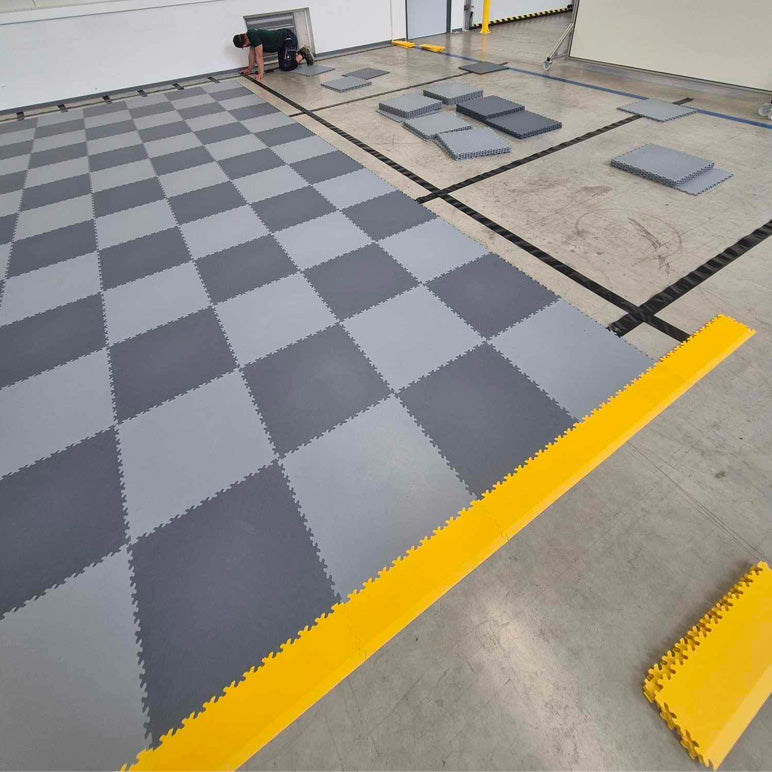
Series ESD is designed for rooms requiring electrostatically conductive floor coverings.
Meets the requirements of IEC 61340-5-1
Has the highest mechanical strength, prevents damage to the surface by handling equipment or massive point loads.
- Made in Europe
- Can be assembled in sections without interrupting operations
- Highly durable, homogeneous material
- Easy maintenance and surface cleaning
ESD floor
Le sol ESD, ou revêtement antistatique électroconducteur, est une solution essentielle pour tous les environnements à haute sensibilité électrique. Il permet de prévenir les décharges électrostatiques (ElectroStatic Discharge) susceptibles d’endommager les composants électroniques, de perturber des systèmes critiques ou de provoquer des incendies en zones ATEX. Ce type de revêtement de sol technique est notamment utilisé dans l’industrie électronique, les laboratoires pharmaceutiques, les établissements médicaux, les data centers ou encore les lignes de production automatisées.
Installer un sol ESD performant, c’est répondre à des exigences précises en matière de sécurité, de conformité aux normes (EN 61340, IEC 61340, etc.), mais aussi de durabilité. Ce guide vous accompagne pas à pas pour comprendre les spécificités de ce revêtement, choisir la solution adaptée à vos contraintes, et garantir une pose conforme et efficace. Un indispensable pour tous les professionnels soucieux de maîtriser les risques électrostatiques.
What is an ESD floor and why is it essential in certain environments?
ESD (ElectroStatic Discharge) flooring is a type of covering specifically designed to avoid or control electrostatic discharges. This phenomenon, often imperceptible to the naked eye or to the touch, can nevertheless cause significant damage, particularly in the industrial, electronic and medical sectors, or in explosive environments classified as ATEX.
But why can a simple floor covering play such a decisive role? Because it is the last line of defence between the electrostatic charges accumulated by people or equipment, and the sensitive devices or substances present in the working environment.
Understanding the phenomenon of electrostatic discharge
Electrostatic discharge occurs when a person or object carrying an electrical charge comes into contact with, or approaches, another object with a different potential. This shock, although sometimes imperceptible, can have catastrophic consequences in sensitive environments: alteration or destruction of electronic components, interruption of production, ignition of flammable dusts or vapors, technical failures, etc.
It's important to remember that humans don't usually feel a shock until it reaches 3,000 volts... but some electronic components, such as semiconductors, can be damaged by as little as 100 volts. Hence the importance of ESD protection, and the floor is a central element in this safety chain.
The strategic role of soil in an ESD zone
An ESD floor covering doesn't just attenuate charges: it actively participates in their dissipation, allowing them to be conducted to earth. This makes it an essential electrostatic protection tool in any EPA (Electrostatic Protected Area) environment.
Unlike a simple antistatic floor, which only limits the accumulation of charges, the ESD floor actively conducts electricity to an earthing point via a system of copper strips and an electrical connection kit. This ensures rapid, controlled evacuation of any charge generated by the movement of people, machinery or materials.
In which environments is an ESD floor recommended?
ESD flooring is strongly recommended, if not mandatory, in many sectors:
- Electronics and microtechnology industries: to prevent damage to components during assembly.
- Pharmaceuticals and hospitals: to preserve the reliability of equipment (MRI, operating theatres) and avoid contamination.
- Chemical and petrochemical industry: to reduce the risk of explosion in the presence of volatile products.
- Aeronautics, space and defense: to guarantee the reliability of critical components and prevent failure due to overvoltage.
Clean rooms and clean areas: where the slightest spark or particle can compromise hygiene or the results of manufacturing processes.
ESD or antistatic flooring: what's the real difference?
ESD flooring is often confused with antistatic flooring. Yet the differences are fundamental:
- Antistatic flooring prevents the accumulation of charges, but does not conduct them to earth. It is useful for avoiding shocks to the hand, improving user comfort or limiting dust attraction.
- ESD flooring, meanwhile, limits charges and drains them effectively to earth. It complies with strict standards such as IEC 61340 or EN 1081, which require electrical resistivity measurements of less than 10⁹ ohms.
In short: all ESD floors are antistatic, but not all antistatic floors are ESD.
Standards for ESD-compliant flooring
Choosing an ESD floor covering is more than just laying it. It must meet precise standards:
- IEC 61340-5-1: the international reference standard for ESD zones.
- EN 1081: European standard for measuring the electrical resistivity of soils.
- ANSI/ESD S20.20: American standard widely used in the electronics industry.
According to the adopted standard, an ESD floor must guarantee an earthing resistance of less than 10⁹ Ohms and, in some cases, less than 10⁸ Ohms, or even 10⁶ Ohms for critical applications.
Why is investing in ESD flooring a strategic choice?
Choosing an ESD floor means :
- Protect your electronic equipment and avoid production losses.
- Meet regulatory and standards requirements.
- Keeping people safe, especially in high-risk environments.
- Extend the lifespan of equipment and infrastructure.
- Gain peace of mind and compliance during quality audits or certifications.
What type of ESD flooring should I choose? Materials, processing and application examples
Once the need for an ESD floor has been established, the key step is to choose the flooring. Not all ESD floors are created equal, and your decision must take into account the constraints of your environment, the intensity of traffic, the level of protection required, as well as long-term maintenance.
The main ESD coating families
1. PVC ESD clip-on tiles
Conductive PVC clip-on tiles are among the most widely used solutions. Sturdy, easy to install and maintain, they are perfectly suited to industrial environments where business interruptions must be kept to a minimum.
Advantages:
- Quick glueless installation (can be done in the field)
- Excellent mechanical resistance (foot and light vehicle traffic)
- Simple maintenance
- Easy replacement of damaged tiles
Application example: An electronics maintenance workshop can install 100 m² of ESD floor clip-on tiles in a single day, without stopping production.
2. Conductive vinyl rolls
ESD roller coatings are recommended for cleaner environments, such as laboratories, hospitals or areas with controlled atmospheres.
Advantages:
- Smooth aesthetic finish
- Easy to clean (no gaskets)
- Good flatness
Limits:
- Longer installation times (gluing required)
- Rigorous soil preparation
- Less suitable for mechanical environments or heavy loads
3. ESD floors in epoxy resin or polyurethane
These cast coatings offer very high chemical resistance and a homogeneous finish. They are generally used in the pharmaceutical, chemical and food industries.
Advantages:
- Extreme resistance to wear and chemicals
- Seamless surface = perfect hygiene
- Very professional appearance
Limits:
- Time-consuming and costly installation
- Mandatory production shutdown for several days
- More complex compensation in the event of damage
Installation: key points to bear in mind
Whatever type of ESD floor you choose, the quality of the installation is crucial to guaranteeing its performance:
- Mandatory grounding via copper strap and grounding kit
- Electrical continuity test between tiles/rollers and earth point
- Use ESD-compatible adhesives and accessories
- Post-installation validation by resistance and electrostatic charge test
The ESD system is always comprehensive: the floor alone is not enough. It must be integrated into a strategy that includes ESD shoes, conductive work surfaces, wristbands, etc.
Successful integration case study: cleanroom & electronics
In an electronic board production room, the ESD floor chosen was a Gerflor vinyl roll, combined with grounding strips every 2 meters. The result: fewer rejects and zero breakdowns due to static electricity over 18 months.
ESD floor installation, care and maintenance: what you need to know
Installing an ESD floor requires rigor, meticulous preparation and a perfect understanding of electrostatic standards. Unlike traditional floors, these technical floor coverings need to be installed correctly to guarantee their effectiveness in dissipating electrostatic charges.
Preparing the substrate: an essential step
Before installation, the substrate must be dry, clean, even and sound. Adhesive residues, cracks, moisture or irregularities can compromise the effectiveness of the ESD coating. A poorly prepared floor can lead to insulating zones, preventing the proper dissipation of loads.
➡️ It is therefore essential to :
- Level off if necessary,
- Measure humidity with a hygrometer,
- Clean and sand to ensure adhesion.
Grounding: an absolute must
An ESD floor only works if it is connected to a ground. This ground allows accumulated charges to evacuate quickly, thus avoiding electrostatic discharges (ESD) which can damage equipment or endanger people.
💡 In practice:
- Conductive copper strips are applied to the substrate.
- They are connected to a certified earthing system.
- A check with an ohmmeter should be made after installation (values below 10⁹ Ohms).
Choosing the right installation method
Depending on the type of ESD floor, the installation method differs:
- ESD clip-on tiles: floating installation, no glue required. Extremely practical for active environments and renovation projects. Quick, modular installation.
- ESD glue-on rolls: require conductive glue. Joints are heat-welded to ensure perfect electrical continuity.
- ESD resins: applied in several coats (primer, conductive, finish). Longer application, with longer drying time. Recommended for high-stress areas.
ESD floor maintenance: don't neglect the routine
Unsuitable maintenance can cancel out the antistatic properties of the coating. It's crucial to choose compatible products and adopt a rigorous routine.
✅ To be preferred :
- Neutral detergents without silicone, wax or film-forming agents.
- Scrubbers with powerful suction.
- Manual washing with microfibres for small areas.
❌ To avoid:
- Aggressive or acidic products.
- Detergents containing insulating agents.
- Allow water to stagnate.
Regular maintenance and checks
To ensure compliance and durability of the ESD coating, it is recommended to :
- Carry out an annual soil/ground resistance audit.
- Check connections to copper strips.
- Check conductivity at various points.
If a tile is damaged, it can easily be replaced. For rollers, spot repair by welding is possible. In the event of major deterioration, a new topcoat can be applied to ESD resins.
🛠️ If the environment is modified (new equipment, change of logistics flow, etc.), compliance must be verified. The floor is an integral part of an overall antistatic ecosystem, including ESD footwear, earthed work surfaces, wristbands, gloves and suitable PPE.