Antistatic flooring and ESD flooring: at first glance, these two terms seem complex, but they're actually quite simple to understand. By understanding their differences, you'll be able to choose the PVC floor covering that best suits your needs.
Antistatic flooring: what does "antistatic" mean?
First of all, the term "antistatic" refers to a product designed to reduce or prevent the build-up of static electricity. In fact, when you move, you generate a static charge, mainly due to friction between your clothes and another surface: this surface could be your body, your hair or other items of clothing. Of course, it's best to prevent charges from building up, because while the charge itself isn't dangerous, it's the potential discharge that is.
This electrostatic discharge creates sparks that can be life-threatening in potentially explosive atmospheres, such as ATEX (explosive atmospheres). In the case of antistatic flooring, the top layer of the coating dissipates static electricity over the entire surface, so that there is no build-up large enough to generate a discharge.
Searches for PVC industrial floor tiles are very often associated with searches for antistatic PVC tiles. Indeed, this type of flooring is considered robust and easy to maintain, and will certainly improve your daily comfort. What's more, installation is quick and easy, so you can start enjoying your new conductive floor as soon as possible.
ESD flooring: what is it?
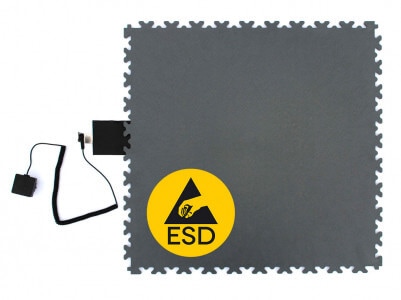
ESD stands for Electrostatic Sensitive Device, or simply electroconductive sol. Similar to the antistatic concept, the ESD coating also has dissipative qualities and aims to ensure that charges can disperse as quickly as possible to avoid electrostatic discharges. What differentiates this project from antistatic is that ESD protection is primarily aimed at protecting a product or production process, rather than a person in its own right. ESD products should therefore not be considered as PPE (personal protective equipment). In fact, an ESD antistatic floor antistatic flooring is designed for use, for example, in production areas, electrical equipment, garages, workshops or any business where people work with electrical equipment: in areas where staff work with electronic chips, for example, or with highly sensitive equipment, it is preferable to choose ESD accessories rather than simply antistatic ones.
Last but not least, all our ESD clip-on floor tiles comply with the requirements of IEC 61340-5-1, and installation is very simple thanks to the accessories available in our installation kit, which will help the slab to be laid more quickly.
Two ESD slab thicknesses are available:
-
4mm (for loads under 1 ton)
-
7mm (Loads over 1 ton)
Accessories: We use a minimum of 2 grounding tile kits. This ensures that a 2nd kit is available in case one breaks down. We also use 2.5 linear meters of ESD tape per square meter.
For further information, please refer to our product data sheets, and check out our new products on the website.
For more information, please contact us: https://www.mosaik-floor.fr/pages/demande-de-devis