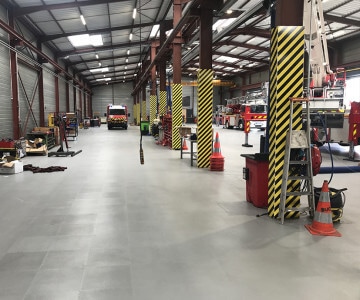
Industrial premises are a very specific environment. Large surfaces of several thousand square meters, existing cement or concrete put to the test, high or very cold temperatures, mandatory French or European classification, watertight floors that must withstand thermal shocks... The criteria are numerous in the industrial field.
The renovation of industrial premises is often carried out on worn, cracked or even totally degraded concrete. Hence the need to install an antibacterial floor, a anti-slip floor known for its robustness, while keeping the cost under control. Because although it's not the main criterion, it's still worth saving a good number of euros by choosing the right industrial floor.
Our industrial flooring in PVC slabs is designed for every sector of activity (industrial environments in general, garages, storage areas, even at high temperatures, food processing industries) to support all types of loads: electric carts, trucks, containers, etc. A thickness for every use.
The disadvantages of other resin, epoxy, polyurethane and other solutions
There's no such thing as an ideal floor. However, a durable industrial floor requires certain characteristics.
There are some good epoxy resins but the choice is vast. You have to be careful and choose quality.
These industrial and commercial floor coverings look great if you opt for the professional ranges.
However, this floor solution is much more cumbersome to apply.
Unlike PVC inset tilesYou are completely dependent on the quality of the original floor. It's not uncommon to have to degrease the floor with a specific acid treatment, apply a primer or do some mechanical sanding before laying the floor. It's no coincidence that some resins come off in patches after a few months, and sometimes even a few weeks.
The disadvantages of resin coating
The first risk is the immobilization of your business. This option also requires a laying and drying time of several days, which is not the case with interlocking tiles, as they can be rolled or walked on as soon as they are laid. The total cost of the renovation operation must therefore take into account the time required to immobilize the premises or production. All equipment has to be moved to pour the epoxy resin on the floor.
In this respect, the PVC flooring. No need to move the machines, you can cut around them without any problems.
Resin offers no soundproofing benefit, while tiles deliver an average 10/15 decibel gain. In thermal terms, plastic tiles also deliver an average gain of 2° on the floor. This can have a positive impact on heating bills.
Our advice: opt for the more versatile solution of PVC tiles
In short, choosing epoxy is a heavyweight option that requires installation by serious professionals. And depending on the square meters involved, the bill can quickly skyrocket.
On the contrary, the interlocking floor can be assembled by almost anyone, does not immobilize activity, compensates well for minor unevenness" of the floor, reduces musculo-skeletal risks and is non-slip to R10 standard.
Some health insurance funds will cover part of the investment for the two above-mentioned items in industry, garage, body shop, production workshop and so on. Example at your disposal.
For each project, we quickly study your needs together.
Our offer is sent within 24 hours.